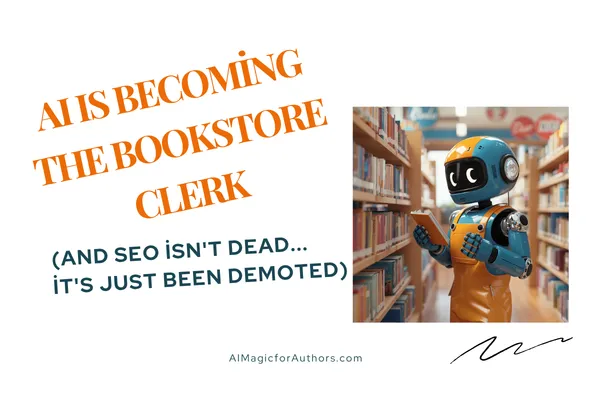
AI Is Becoming the Bookstore Clerk
(and SEO isn't dead... it's just been demoted)
Picture a bookstore.
Not the browsing kind — where you wander the shelves, pick up covers, read the back, put it down, pick up another one.
The other kind. Where you walk straight to the clerk and say:
"I want a book like this — but make it funnier / darker / gentler / witchier."
That clerk doesn't hand you a list of every book in the store. They make a match. Quickly. Confidently. Based on everything they know about what you just described.
That clerk is increasingly AI.
And if AI can't place you — can't describe what you write, who it's for, and why it fits — you're not in the conversation.
That's what this post is about.
The sticky-note version
AI discovery is shifting from search → click to ask → answer → decide.
Which means: your book won't just be found — it will be chosen inside a conversation.
SEO isn't dead. It's been demoted. It's the plumbing, not the strategy.
The new stack is:
Findable (clean pages + metadata)
Selectable (reader-fit clarity: genre, tropes, comps, series order, promise)
Trustable (consistent signals across the public web)
No guarantees you'll be recommended — just better odds, fewer mismatches, and compounding visibility.
The shift underneath everything: people aren't browsing first anymore
We're used to discovering new books like this:
Search. Scroll. Click. Compare. Decide.
But AI nudges it toward:
Ask. Receive an answer. Decide.
That's not a small shift. It's a behaviour change.
When the recommendation happens inside the conversation, your visibility depends on whether you're easy to match to that request.
Readers are already doing this — quietly, quickly, and without asking anyone's permission.
What the business world figured out first — and why it matters for authors
A retail business in Toronto recently received 50 orders that traced back to ChatGPT. Not clicks. Not traffic. Orders — placed inside the conversation. ChatGPT had recommended them, and customers acted on it without ever leaving the chat.
Then personalized advertising started showing up inside AI-driven conversations. You're asking AI for a book recommendation... and it doesn't just list titles — it can surface a deal, a bundle, a prompt to purchase.
The business world is already treating AI as a discovery and conversion channel. Most authors haven't caught up yet.
Here's what that means in practice.
1) AI is becoming a real discovery channel
"I found your book because I asked ChatGPT/Gemini/Claude..." is becoming a normal sentence.
Once something becomes a regular ask, it becomes the path to find it.
2) The void is the point
We're not optimizing for one algorithm anymore.
We're building a footprint that holds up across systems.
Newsletter, LinkedIn, Amazon, Goodreads, your website — they're no longer separate platforms. They're your ecosystem.
The winning move isn't "hack the machine." It's: be consistently legible. You don't have to be everywhere. You just have to be coherent wherever you are.
3) Trust is the bottleneck now
Recommendations are easy to generate. Trust is harder to build.
Readers are already wary of bias, manipulation, and weirdly confident wrong answers.
So "trustable" becomes part of discoverability — not just good branding, but making sure your values and your work are clearly articulated in public.
4) AI pulls from the messy public web
Not just your official pages.
It learns who you are from everything that's public: reviews, discussions, interviews, summaries, reader chatter, blog posts, captions, forum posts.
(Which is both comforting and horrifying.)
The clearer and more consistent you are across all of these, the easier it is for AI to include you — and include you accurately.

Business clarity isn't author clarity
Here's the most important distinction in all of this:
Businesses win with clarity like specs, shipping policies, availability, discounts, bundles, "free delivery by Tuesday."
Authors win with a different kind of clarity.
Reader-fit clarity.
Meaning:
What genre is this — really?
What feelings does it deliver?
What tropes show up?
What books are like yours?
Where should a new reader start (if it's a series)?
What promise does Book 1 make — and does it keep it?
It's the thing that helps a human — or an AI — decide:
Yes. This is what I want.
So... what happens to SEO?
SEO isn't dead. It's been demoted.
Think of SEO as the plumbing. It helps systems find you, crawl you, and understand your pages.
But SEO alone doesn't guarantee you'll be recommended. In an answer-first world, the AI may summarize without sending clicks anywhere. And when it does list options, it still has to decide which ones fit best.
So the discoverability goal expands:
Findable = the plumbing works
Selectable = you match the prompt
Trustable = the system feels confident naming you, and the reader feels good choosing you
A single-sentence version:
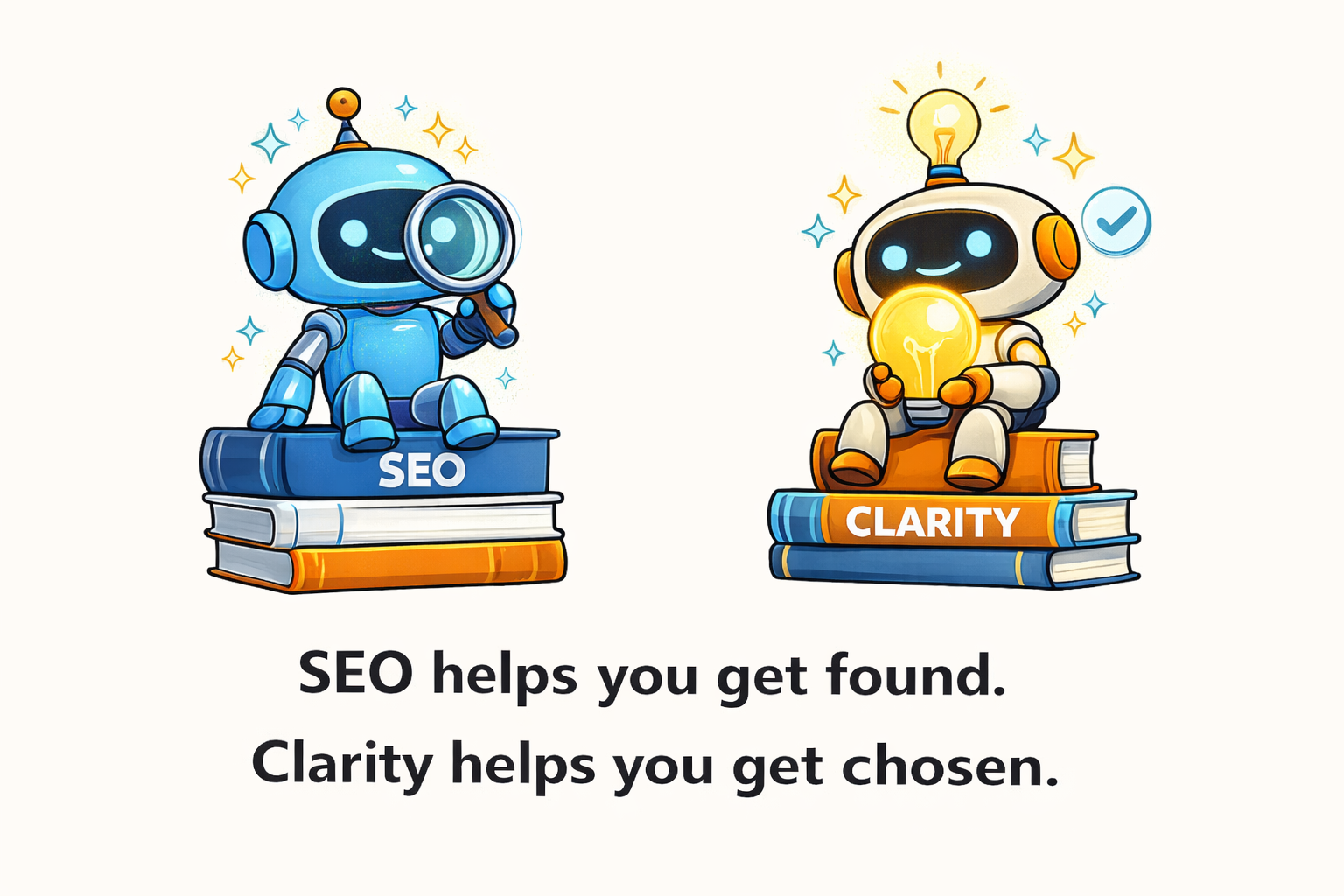
SEO helps you get found. Clarity helps you get chosen.
The uncomfortable question: does clarity guarantee you'll be recommended?
No.
There is no magic checkbox where you do the right metadata and the AI gods reward you with a steady stream of readers.
These systems make a best guess based on the question, the context, and what they can see.
But clarity buys you real advantages:
you're easier to classify
you're less likely to be mis-shelved (wrong genre, wrong vibe, wrong expectation)
you provide stronger confidence signals
when you are surfaced, your pages convert better
your footprint compounds over time
Clarity doesn't guarantee discovery.
Clarity makes you recommendable.
What to do now (and why timing matters)
This is a compounding game.
A year from now, more authors will catch on, basic clarity will be table stakes, the conversation layer will be more crowded, and the systems will have more data to draw from.
Which is great — if you already exist clearly in public.
That realization is what led me to build the AI Visibility Audit: a structured way to find out what AI can currently see about you, where the gaps and contradictions are, and exactly what to fix. I ran it on my own newsletter first. The results were not what I expected — and fixing them took one morning.
Publishing into the void has more value than subscriber counts suggest. Every post is part of your discoverability ecosystem. It builds trust — a baseline of who you are, in public, over time.
One last word
I'm not interested in whether AI is writing your book or not.
I'm interested in AI supporting the systems around your writing — so it acts like an assistant and systems partner.
Everything here is part of that systems work: making your book easy to find, easy to classify, and easy to trust.
If you're curious how AI sees you across all three layers — Findable, Selectable, and Trustable — an AI Visibility Audit will show you exactly where you stand and what to fix first.
Learn more about the AI Visibility Audit → Work with Me
Part of the AI Visibility series: [Findable] | [Selectable] | [Trustable]
